Understand the process before choosing a tool
Automation can help reduce repetitive tasks and organize the flow of information. But the decision starts with a question: what problem does the company need to solve?
A time-consuming task may hide unclear rules, incomplete information, or undefined responsibilities. Reproducing these difficulties in an automated flow does not resolve their cause. Before choosing technology, it is therefore necessary to understand how the work actually happens.
Which signs deserve attention?
Some situations indicate an opportunity worth investigating: repeated information across systems, frequent forwarding tasks, manual notifications, and difficulty tracking the stages of a request.
Frequency and volume matter, but they are not the only criteria. It is also useful to consider errors and delays, dependencies between people and systems, exceptions, implementation effort, and expected benefit. The analysis considers the whole process, not just an isolated activity.
When should you adjust, configure, integrate, or develop?
Not every improvement requires a new application. If the difficulty lies in defining stages or responsibilities, adjusting the process may be the first step. If the current tool already offers the required feature, configuration may be enough.
When information needs to move between applications, systems integration may be part of the answer. If rules and needs require a dedicated solution, custom software can bring the stages together and coordinate them. These alternatives can work together.
When is it better not to automate yet?
Unclear rules and exceptions nobody has been able to explain call for investigation before implementation. The same applies to decisions requiring human judgment: technology can gather information and support the work while the decision remains with the responsible person.
A first delivery with clear boundaries also lets the team evaluate the flow before expanding its reach. The choice depends on the project’s needs and conditions.
An illustrative example
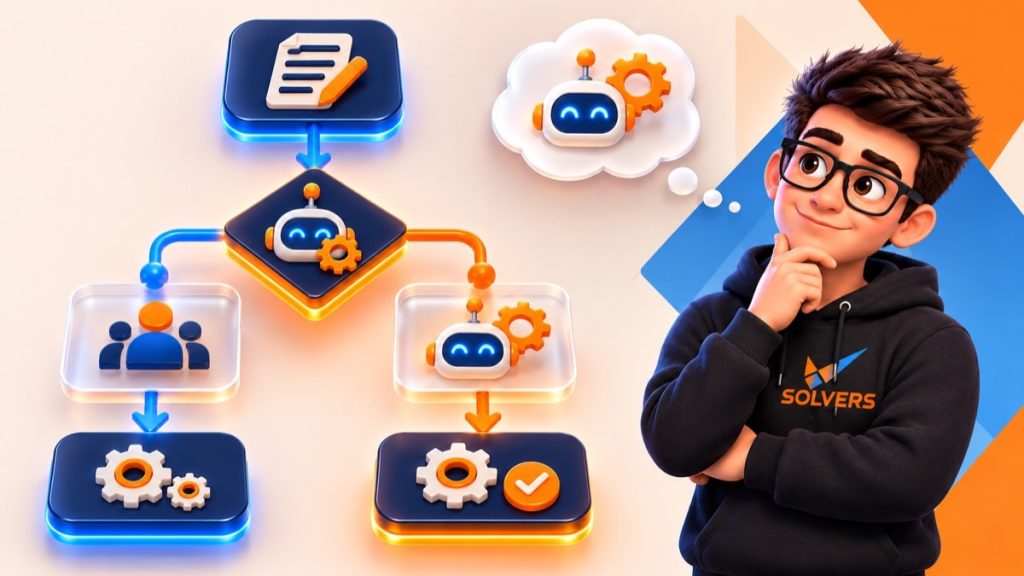
Imagine a company where acceptance of a proposal must reach the team starting the project. Automation could gather the necessary information and send it to the responsible person. Before that, however, the team must define what constitutes acceptance, which data are mandatory, and who resolves outstanding issues.
This fictional example does not represent a client case or result. Rules and solution design depend on each operation.
Technology follows the need
Among other possibilities, Solvers uses Apache NiFi, Apache Kafka, n8n, APIs, databases, and RabbitMQ. The list is not exhaustive: the choice starts with the process and the project’s need.
Artificial Intelligence can also be assessed as an automation or integration tool, considering costs, the risk of judgment errors, and human oversight. Its use depends on the case.
See how we conduct process automation.
Contact Solvers: WhatsApp +55 11 97087-9021 or contato@solvers.com.br.