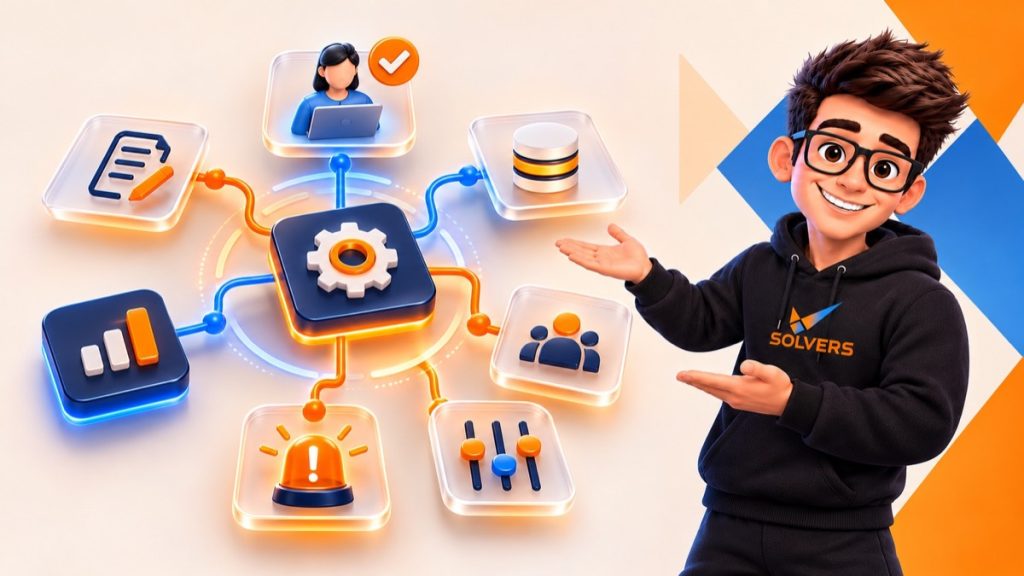
Control begins before automation
Useful automation must reflect the process the company wants to execute. This requires understanding what starts the work, which information flows, who makes decisions, and what results are expected.
Talking to people who know and perform the routine helps reveal rules and exceptions that do not always appear in an initial diagram. The mapping should be validated with the client and guide project decisions.
Map rules, owners, and exceptions
For each stage, clarify who participates, what data are needed, and what continuity depends on. It is also important to identify approvals, unusual situations, and the systems involved.
If information is missing or a condition is not met, the flow needs to anticipate how the issue will be routed. For decisions requiring judgment, automation can support the responsible person without replacing them.
Define controls proportional to the process
Depending on the need, the design may consider human approval, records of actions taken, identification of responsible people, and alerts. These mechanisms help explain what happened and who should act when an issue arises.
There is no single list of controls suitable for every project. Their definition depends on the rules, risks, and operational context.
Prepare the flow for failures between systems
When automation exchanges information, systems integration must consider situations such as a missing response or confirmation. Handling must account for how to identify the issue and prevent a retry from causing duplication.
Fictional example: a request is sent to another system, but confirmation does not arrive. Before resending, the flow might provide for verification or routing for review. The solution depends on system capabilities and rules agreed with the client.
Start with clear boundaries and validate with users
When appropriate, a first delivery can cover a bounded part of the routine, with defined objectives, rules, and validation criteria. The client’s team participates by clarifying questions, providing necessary information and access, and validating deliveries.
Based on that evaluation, next stages can be prioritized according to needs and observed results. After implementation, monitoring, support, and maintenance follow the conditions agreed for each project.
The tool follows the need
Automation can combine custom development, existing capabilities, and integration. AI may also be considered in appropriate situations, with attention to cost, the risk of incorrect decisions, and human oversight.
The goal is to build a flow understandable to participants, with clear rules and responsibilities. See how we conduct process automation.
Contact Solvers: WhatsApp +55 11 97087-9021 or contato@solvers.com.br.